
Glitter Powder Supplier for Cosmetic Brands: Grades, Testing, and OEM Sourcing
Competitive Gap Analysis
A cosmetic glitter powder supplier should qualify the particle grade, finished formula, and dispenser together before a brand commits to bulk production.
- Suspension is a rheology problem, not just a viscosity problem. A single viscosity reading cannot show whether a body oil will suspend shimmer at rest or redisperse after storage. Buyers should request the measurement conditions and agree on settling and redispersion criteria.
- Fast dry-down does not prove low transfer. Isododecane can speed evaporation, while hemisqualane can improve spread and reduce a greasy feel. Neither carrier alone determines how much shimmer transfers to fabric after application.
- Microplastic status depends on the complete particle. A cellulose core does not establish EU compliance when a coating, binder, or other component contains a synthetic polymer. Buyers need grade-specific composition and supporting evidence.
- Nozzle diameter alone does not predict clogging. The largest particles, agglomerates, and the narrowest passage in the actuator or valve determine whether a package can reliably dispense a shimmer formula.
- Retail-pack and bulk powder MOQs are not interchangeable. A 100-piece-per-shade private label run and a kilogram-based ingredient order use different quote units. Buyers should confirm net fill weight, pack configuration, and the minimum kilograms per grade before comparing quotations.
Key Facts at a Glance
MLM Glitter is a direct cosmetic glitter powder supplier and OEM/ODM manufacturer in Shenzhen, China, with a 100-piece starting MOQ for private label retail packs.
- Particle size: Available grades span 10–200 µm; the distribution and upper particle-size limit depend on the selected grade.
- Material platforms: MLM Glitter offers cosmetic-grade synthetic fluorphlogopite and biodegradable cellulose glitter options. Confirm composition and biodegradation evidence for the specific cellulose grade.
- Retail-pack MOQ: Private label orders start at 100 pieces per shade. Bulk powder is quoted in kilograms, with minimums confirmed by grade and shade.
- Lab samples: Prototypes dispatch in 3–7 business days. Sample fees are credited against bulk production orders.
- Bulk production: Standard production turnaround is 25–35 days. Freight and customs timing should be quoted separately.
- Lead testing: Buyers specifying Pb < 2 ppm should request an applicable COA supported by an Agilent 7800 ICP-MS report. The limit is a purchase specification to verify against the tested lot, not an every-lot claim.
- Commercial documentation: Batch COAs, MSDS/SDS, complete ingredient lists, and applicable test reports are provided on qualified commercial inquiry. Confirm document scope and lot coverage before placing an order.
Specification Comparison Table
Bulk glitter powder suits brands with an established formulation and filling partner, while finished-product OEM suits brands that want MLM Glitter to develop the formula and qualify the package as a single project.
| Procurement parameter | Bulk cosmetic glitter powder | Private label retail-packed glitter | Finished shimmer body oil OEM |
|---|---|---|---|
| Order minimum | Quoted in kg per grade and shade | From 100 pieces per shade | Private label starts at 100 pieces per shade; confirm custom formula and packaging minimums |
| Lab sample dispatch | 3–7 business days for agreed samples | 3–7 business days for lab prototypes; printed packaging timing quoted separately | 3–7 business days for lab prototypes; additional revisions may extend development |
| Bulk production | 25–35 days standard turnaround; confirm against grade availability | 25–35 days standard turnaround; confirm pack availability | 25–35 days standard turnaround; confirm start date after formula and pack approval |
| Particles and loading | Select grades within 10–200 µm; buyer validates loading in the finished formula | Select grade, shade, and net fill weight | Agree on pearl loading as a percentage by weight after appearance, stability, and dispenser trials |
| Carrier and viscosity | Not applicable to dry powder; request particle-size and composition data | Not applicable to dry powder | Evaluate isododecane, hemisqualane, or other compatible emollients; specify viscosity in mPa·s with temperature, instrument, and test conditions |
| Dispenser compatibility | Buyer validates the finished formula and package | Confirm sifter, jar, or closure against particle grade and dispensing rate | Validate the selected pump, dropper, or spray assembly using the production-intent formula |
| International documentation | Request SDS, COA, ingredient and coating details, and applicable metals reports | Request powder documentation plus market-specific label review inputs | Request finished-formula documents and applicable reports for US safety substantiation, EU PIF/CPNP, and UK SCPN review |
How to Qualify Glitter Powder for Body Oil
Particle size, low-shear behavior, and dispenser design determine whether a glitter grade will perform in a body oil.
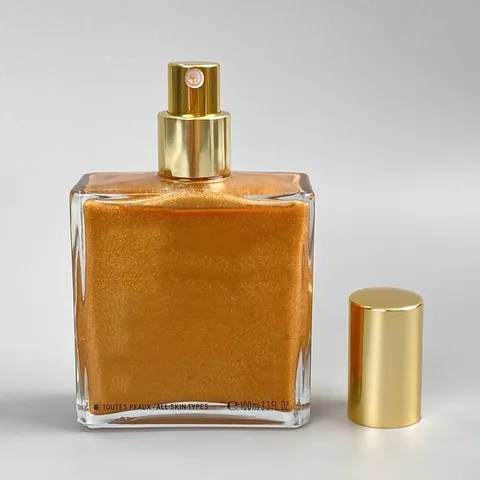
Particle selection for custom glitter body oil
Synthetic fluorphlogopite is a useful starting point for an even pearlescent finish, while cellulose glitter can suit briefs that call for more distinct sparkle. Synthetic fluorphlogopite-based pearls and cellulose glitter should be compared at the intended loading in the same oil base, under the same lighting, and on the same application surfaces. For custom glitter body oil, include a target finish, shade reference, intended application area, and destination market in the sample brief. A bulk powder that looks bright in a jar may produce a subtler effect once dispersed and applied.
Suspension and dispenser testing for private label shimmer body oil
A shimmer oil that looks uniform on sample day can still settle, form a compact sediment, or dispense unevenly after shipping. Larger or denser particles generally settle faster under comparable conditions, but platelet shape, agglomeration, and the oil’s low-shear structure also affect performance. Silica dimethyl silylate or stearalkonium hectorite may support suspension in compatible systems; the selected modifier must also preserve the desired skin feel and dispensing behavior.
For private label shimmer body oil, agree on storage conditions, acceptable settling, redispersion effort, and repeat dispensing before approving the formula. A fine mist component with a nominal 0.12–0.15 mm orifice has an opening of 120–150 µm; a 200 µm upper-size grade should not be presumed compatible. Even a finer grade can clog if particles agglomerate or an upstream flow passage is narrower. Test the production-intent assembly after storage and repeated use; consider a pump or dropper if a fine mist cannot reliably deliver the target sparkle.
Dry-down and transfer acceptance criteria
A dry-touch body oil should be evaluated for residue and fabric transfer separately. Set a fixed application amount, dry-down interval, contact fabric, and visual acceptance threshold. Hold those conditions constant when comparing carrier systems or pearl loadings. A qualified shimmer oil manufacturer can use the same brief to compare prototypes without promising a transfer-proof finish.
US & EU Regulatory Compliance & Export Readiness
Export readiness depends on the exact material, finished product, intended use, and destination market; neither a material COA nor a product notification constitutes regulatory approval.
United States. MLM Glitter supports applicable FDA MoCRA requirements, including facility-registration disclosures and documentation for the responsible person’s product listing and safety substantiation, where required. Verify each color additive’s permitted use under 21 CFR Parts 73 and 74, as applicable; a grade suitable for body use is not automatically suitable for the eye area or lips. For California Proposition 65, request lead and arsenic data appropriate to the product and exposure assessment. A Pb < 2 ppm COA result is a concentration finding, not a universal Prop 65 limit or evidence that no warning is required.
European Union and United Kingdom. For an EU finished cosmetic, the Responsible Person must address Regulation (EC) No 1223/2009, including the Cosmetic Product Safety Report, Product Information File, and CPNP notification before market placement. MLM Glitter can provide supporting ingredient and material documentation on qualified inquiry. Confirm the selected grade’s status under the EU REACH restriction on intentionally added synthetic polymer microparticles using the complete particle composition and relevant supporting evidence. For Great Britain, plan separately for a UK Responsible Person and SCPN notification; an EU CPNP notification does not replace the Great Britain filing.
Logistics. MLM Glitter can quote DDP (Delivered Duty Paid) door-to-door air or sea freight options to eligible destinations in the US, UK, and Europe. Confirm the named place of delivery, importer arrangements, and freight lead time in writing. DDP allocates shipping and customs responsibilities under the agreed terms; DDP does not replace cosmetic market-entry obligations.
Frequently Asked Questions
The following sourcing answers distinguish commercial starting terms from specifications that require grade- or lot-specific verification.
Q: Can MLM Glitter supply glitter powder and private label body oil from the same factory?
Yes. MLM Glitter supplies bulk cosmetic glitter powder and develops finished private label body oil as a direct Shenzhen manufacturer. Private label starts at 100 pieces per shade, while bulk powder minimums are quoted in kilograms. Brands sourcing both formats should confirm whether the same particle grade can meet each application’s requirements.
Q: What particle size should a brand specify for sprayable wholesale shimmer body oil?
The correct particle size is the grade that passes repeat-dispensing tests in the final spray assembly. Specify the upper particle-size limit, not just the average, and compare the grade against the narrowest flow passage. Test the filled package after storage before approving a spray format.
Q: Can a glitter powder supplier document Pb < 2 ppm?
MLM Glitter can provide applicable COAs and ICP-MS reports on qualified commercial inquiry so buyers can verify lead results against a Pb < 2 ppm requirement. Request the tested lot ID, result, reporting limit, and test method. If shipment-specific testing is required, include the scope and acceptance criteria in the purchase specification.
Q: Does biodegradable cellulose glitter automatically meet the EU microplastic restriction?
No. A biodegradable cellulose core alone does not establish the regulatory status of the finished particle. Request the complete grade composition, including coatings or binders, and supporting evidence for the claimed regulatory status before approving the material for an EU launch.
Q: How quickly can a brand receive glitter powder samples and place a bulk order?
MLM Glitter dispatches lab samples in 3–7 business days and quotes 25–35 days for standard bulk production. Sample fees are credited against bulk production orders. Confirm the production start date after grade, formula, and packaging approvals, and allow separate time for transit.
Request a Glitter Powder Quote and Lab Sample Kit
A quote request with the shade, target particle size, order format, dispenser, and destination market gives MLM Glitter enough information to recommend grades and confirm the applicable MOQ.
- 2026 US MoCRA & EU CPNP Export-Ready Formulations & Compliance Whitepaper: Ask the official quote desk for the free direct-download link and use the whitepaper to prepare a market-specific documentation checklist.
- Instant 3-Piece Turnkey Lab Sample Kit Brief: Submit a shade brief and request three sample selections, custom viscosity swatches for finished oils, and the applicable heavy-metal batch COA for California Proposition 65 exposure review. Custom lab prototype fees are credited toward the first bulk production order.
Start with WhatsApp: +86 136 5238 0291 or Request OEM Quote & Lab Samples.