
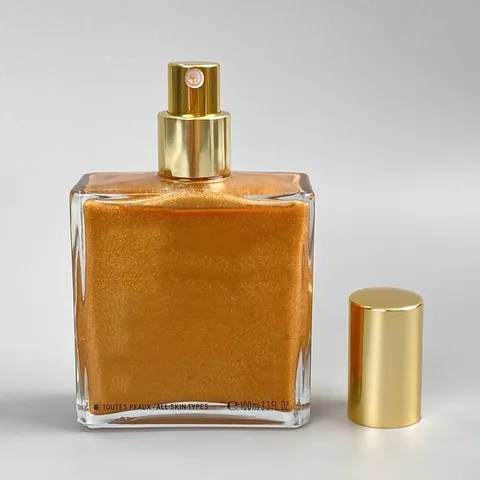
How to Price Private Label Shimmer Body Oil: BOM and Margin Calculator
Competitive Gap Analysis
A reliable private label shimmer body oil margin calculator must account for formulation, packaging, and freight—not just the factory unit price.
- Shimmer suspension affects the real cost of a saleable unit. Pearl size, particle density, and oil-phase rheology influence settling and redispersion. An oil-compatible rheology modifier such as silica dimethyl silylate or an appropriate organoclay can improve suspension, but the finished formula still needs stability and dispensing checks.
- Fast dry-down does not prove transfer resistance. Isododecane and lightweight carriers such as hemisqualane can help create a drier skin feel. Pearl adhesion and residue transfer onto clothing or upholstery still need separate testing on the finished formula.
- A glitter claim is not a microplastics assessment. EU buyers need to evaluate the complete effect-particle composition, including substrates and coatings, against the applicable REACH restriction. A cellulose-based substrate alone does not establish that the finished particle falls outside the restriction.
- Dispenser compatibility cannot be specified by nozzle diameter alone. Pearl size distribution, agglomerates, viscosity, and internal valve clearances all affect priming and clogging. A pump that works with an unpigmented base may fail once the intended shimmer is added.
- Factory-price margin is not landed margin. A $26 retail price yields 83.1% gross margin at a $4.40 factory cost and 86.9% at $3.40, before inbound freight, duties, and other landed charges. Supplier comparisons should use delivered cost per saleable unit.
Key Facts at a Glance
MLM Glitter’s 100-piece private label minimum gives brands a way to test a shade before committing to a larger run.
- Starting MOQ: 100 pieces per shade for eligible private label configurations.
- 100-piece planning model: $4.40 per unit, or $440 before freight and other landed charges.
- 300-piece planning model: $3.40 per unit, or $1,020 before freight and other landed charges.
- Suggested retail benchmark: $26 per unit, producing factory-cost gross margins of 83.1% and 86.9%, respectively.
- Lab sample dispatch: 3–7 business days; sample fees are credited against bulk production orders.
- Bulk production turnaround: 25–35 days; transit time is separate.
- Illustrative DDP allowance: $150 per 100-piece shipment or $240 per 300-piece shipment, equivalent to $1.50 or $0.80 per unit. These allowances are calculator inputs, not route quotes.
MLM Glitter is a direct manufacturer in Shenzhen, China. The pricing scenarios below are procurement planning models, not binding quotations. Final pricing depends on the approved formula, shade count, fill volume, packaging, documentation scope, and delivery destination.
Specification Comparison Table
The 100-piece and 300-piece models compare order economics on the assumption that the product specification stays substantially the same.
| Procurement parameter | 100-piece launch model | 300-piece scale model |
|---|---|---|
| MOQ and modeled quantity | Starting MOQ: 100 pieces per shade; model uses 100 pieces | Model uses 300 pieces of one shade |
| Modeled factory price | $4.40 per unit | $3.40 per unit |
| Lab sample dispatch | 3–7 business days | 3–7 business days |
| Bulk production turnaround | 25–35 days | 25–35 days |
| Carrier options | Standard oil base or quoted lightweight dry-feel base | Same approved base for a like-for-like comparison; reformulation quoted separately |
| Viscosity specification | Set an approved range in mPa·s at a defined temperature and measurement method | Retain the approved range; confirm against the selected dispenser |
| Pearl loading | Specify percentage by weight and particle-size distribution in the approved brief | Retain approved loading and particle specification; requote changes |
| Dispenser compatibility | Evaluate pump or dropper performance with the filled, shimmer-containing prototype | Confirm the production dispenser matches the qualified prototype |
| International documentation | Batch COA, MSDS, and complete ingredient list on qualified commercial inquiry; confirm test-report scope | Same baseline; confirm destination-specific reports and documentation scope before purchase |
| Freight basis | Confirm DDP to a named destination separately | Compare DDP air and sea options where practical |
A viscosity number without a test temperature, measurement method, and packaging context is not a useful purchasing specification. For private label shimmer body oil, approve a filled sample against visible settling, redispersion, dose consistency, and repeat dispensing before locking the unit cost. A packaging change that solves clogging can also change the carton weight, freight cost, and gross margin.
How to Price Private Label Shimmer Body Oil: BOM and Margin Calculator
At a $26 retail price, increasing the modeled order from 100 to 300 pieces cuts factory cost by $1.00 per unit, but increases the upfront factory spend by $580.
Factory BOM and unit-price breakdown
The illustrative breakdown separates materials from conversion and overhead so sourcing teams can compare supplier quotations on the same basis.
| Unit-cost component | 100 pieces | 300 pieces |
|---|---|---|
| Oil base, shimmer blend, and functional additives | $1.30 | $1.05 |
| Primary packaging: bottle and dispenser | $1.55 | $1.20 |
| Filling, assembly, and production handling | $0.75 | $0.55 |
| Label and retail carton | $0.45 | $0.35 |
| Allocated setup and factory overhead | $0.35 | $0.25 |
| Modeled factory unit price | $4.40 | $3.40 |
| Total factory order value | $440 | $1,020 |
The line-item allocations are illustrative, not a disclosure of MLM Glitter’s internal accounting. The table combines a materials BOM with manufacturing and overhead allocations to reconcile to the modeled factory price. Ask the supplier to identify one-time artwork, tooling, and testing charges separately. Add separate charges to the launch budget without counting any amounts already included in the unit quote. Buyers planning a custom bottle or formula can use the contract body oil manufacturing brief to align specifications before comparing prices.
Landed cost, gross margin, and retail price floor
Landed cost per saleable unit is the appropriate cost basis for evaluating whether a shimmer body oil meets a retail gross margin target.
- Factory-cost gross margin:
(net unit selling price − factory unit price) ÷ net unit selling price - Landed unit cost:
(factory order total + DDP charge + other allocable charges not already included) ÷ saleable units received - Landed gross margin:
(net unit selling price − landed unit cost) ÷ net unit selling price - Minimum net selling price for a target gross margin:
landed unit cost ÷ (1 − target gross margin)
| Margin input or output | 100 pieces | 300 pieces |
|---|---|---|
| Suggested retail price, before sales tax or VAT | $26.00 | $26.00 |
| Factory unit price | $4.40 | $3.40 |
| Factory-cost gross margin | 83.1% | 86.9% |
| Illustrative DDP shipment allowance | $150.00 | $240.00 |
| Illustrative DDP allocation per unit | $1.50 | $0.80 |
| Modeled landed unit cost | $5.90 | $4.20 |
| Modeled landed gross margin at $26 | 77.3% | 83.8% |
| Minimum net selling price for 80% landed gross margin | $29.50 | $21.00 |
The example assumes all ordered pieces are saleable and no additional allocable costs apply. At $26, an 80% landed gross margin caps landed unit cost at $5.20. The 100-piece model misses that target by $0.70 per unit; the 300-piece model has $1.00 per unit of headroom. For wholesale, replace the $26 retail price with the brand’s actual wholesale revenue. For direct-to-consumer planning, model discounts, marketplace fees, payment processing, outbound fulfillment, and customer acquisition separately before treating gross margin as contribution margin.
DDP freight estimate and order-size decision
A usable DDP estimate requires a named delivery destination, final packed dimensions, and a written breakdown of included charges.
Supply the destination postal code, carton count, carton dimensions, gross weight, and target delivery date. Request air and sea comparisons where available, and confirm delivery scope, duty and import tax treatment, and responsibility for customs clearance. Do not add duties or brokerage twice when the quoted DDP charge already includes those amounts. Fragranced or volatile formulations may require a transport classification review before the carrier confirms pricing.
Under the illustrative allowances, the 100-piece order requires $590 in delivered inventory spend, while the 300-piece order requires $1,260. The larger order lowers landed cost by $1.70 per unit but ties up $670 more upfront. The 100-piece tier can be the better launch decision when the brand still needs to validate shade demand, dispenser performance, or repeat purchase rates.
US & EU Regulatory Compliance & Export Readiness
Export readiness depends on the finished formula, intended use, and destination-specific obligations; a supplier COA alone does not establish market compliance.
United States. MLM Glitter supports applicable MoCRA requirements through facility registration disclosures where applicable and documentation for cosmetic safety substantiation. The brand should confirm the responsible person’s product listing, labeling, and safety obligations. Colorants must be permitted for the intended cosmetic use under applicable FDA requirements, including 21 CFR Parts 73 or 74 and batch certification where required. California Proposition 65 is exposure-based: lead and arsenic test results can support an assessment, but a concentration result alone does not establish whether a warning is required. Factory support does not constitute FDA approval.
European Union and United Kingdom. For the EU, buyers should confirm compliance with Regulation (EC) No 1223/2009, including a Cosmetic Product Safety Report, Product Information File, EU Responsible Person, and CPNP notification. Review the finished shimmer particle against the EU REACH restriction on synthetic polymer microparticles, including applicable scope, exemptions, and transition periods. For Great Britain, confirm the UK Responsible Person and SCPN notification requirements separately. Northern Ireland generally follows the EU cosmetics framework.
Documentation and logistics. MLM Glitter provides MSDS, batch COA, complete ingredient lists, and applicable available test reports on qualified commercial inquiry. Confirm the test method, analytes, batch reference, and any additional testing requirements before placing the purchase order. DDP door-to-door air or sea freight options can be quoted for destinations in the United States, the United Kingdom, and Europe, subject to route and product eligibility.
Frequently Asked Questions
A useful sourcing FAQ distinguishes the advertised factory margin from the margin a brand can expect after inbound costs.
Q: What is the MOQ for private label shimmer body oil?
MLM Glitter’s private label MOQ starts at 100 pieces per shade for eligible configurations. Custom dispensers, decorated bottles, or special-order materials may carry different component minimums; confirm those minimums before approving the design.
Q: What gross margin does a $26 shimmer body oil earn?
At $26 retail, gross margin is 83.1% at a $4.40 factory unit price and 86.9% at a $3.40 factory unit price. With illustrative landed costs of $5.90 and $4.20, gross margins are 77.3% and 83.8%, respectively, before channel and selling expenses.
Q: How much should I budget for DDP shipping on 100 or 300 bottles?
Use $150 for 100 bottles and $240 for 300 bottles strictly as initial calculator allowances, not confirmed DDP rates. A formal estimate requires the destination, shipment dimensions, weight, transport classification, and delivery terms.
Q: How long do private label shimmer body oil samples and bulk production take?
MLM Glitter dispatches lab samples in 3–7 business days and offers a 25–35 day bulk production turnaround. Sample fees are credited against bulk production orders; sample transit and finished-goods freight are separate from dispatch and production timelines.
Q: What documentation can buyers request before committing to production?
Qualified commercial buyers can request MSDS, COA, complete ingredient lists, and applicable available test reports from MLM Glitter. Confirm whether a report covers a raw material, a prototype, or the planned production batch, and request a quote for any additional testing needed for the target market.
Request a Landed-Cost Quote and Lab Sample Kit
A quote that prices the same shade, fill volume, and dispenser at both 100 and 300 pieces gives buyers a defensible basis for choosing a launch quantity.
- 2026 US MoCRA & EU CPNP Export-Ready Formulations & Compliance Whitepaper (Free Direct Download): Request the direct download link and use the checklist to identify documentation gaps before issuing a purchase order.
- Instant 3-Piece Turnkey Lab Sample Kit Brief: Submit a target shade, preferred finish, reference viscosity, bottle format, and destination postal code. Request custom viscosity swatches and specify California Proposition 65 lead and arsenic reporting needs in the batch COA or supporting lab report brief. Documentation is provided on qualified commercial inquiry; confirm report scope and availability with the quote. Lab sample fees are credited against bulk production orders.
Start with WhatsApp (+86 136 5238 0291) for a side-by-side 100- and 300-piece quote, or Request OEM Quote & Lab Samples through the official MLM Glitter desk.