
+---------------------------------------------------------------------------------------------------+
|  PILOT-SCALE PRESSING SPECIFICATION: CHAMELEON POWDER CAKES                                      |
|  Substrate: High-Purity Synthetic Silica Flakes (D50: 35 um +/- 3 um; Thickness: 350-450 nm)     |
|  Binder Load: 8.5% - 10.5% w/w | Hydraulic Compaction Force: 8.5 MPa | De-aeration Dwell: 1.8 s   |
|  Pan Standard: 26mm Tinplate (SPTE, 0.22mm gauge) for direct magnetic induction retention        |
+---------------------------------------------------------------------------------------------------+
In conventional color cosmetic contract manufacturing, formulating thin-film interference pigments requires high capital expenditures. Standard multi-cavity automated powder presses (e.g., VEGA or Kemwall lines) require minimum bulk powder charges of 15 to 25 kg per run to balance hopper feed screws, forcing brands into 3,000-to-5,000-unit minimum order quantities (MOQs). Furthermore, using high-speed stamping presses calibrated for standard talc or sericite mica crushes delicate multi-chrome flakes, stripping the variable optical path and yielding a flat, muddy grey payoff.
By deploying manual and semi-automated pneumatic/hydraulic presses with micro-tooled single-cavity dies, contract plants can compound, press, and assemble custom chameleon eyeshadows at production runs between 100 and 300 units without sacrificing optical brilliance or mechanical stability.
1. Optical Physics & Substrate Metallurgy: Thin-Film Interference
Chameleon pigments do not function like standard absorption colorants or single-substrate mica pearls. They are engineered optical interference filters manufactured via precision chemical vapor deposition (CVD) or wet-chemical deposition onto synthetic platelet substrates.
      Incident Light Beam (I_0)
            \              /  Reflected Wave R_1 (Upper Boundary)
             \            /
    ══════════▼══════════▲══════════  Dielectric Layer 1: TiO2 / Fe2O3 (High Refractive Index n_1 ~ 2.5)
               \        /
                \      /
    ─────────────▼────▲─────────────  Core Substrate: Ultra-Flat Synthetic Silica (Low n_2 ~ 1.46)
                  \  /
    ═══════════════▼▲═══════════════  Dielectric Layer 2: TiO2 / Fe2O3 (High Refractive Index n_1 ~ 2.5)
                    \
                     Reflected Wave R_2 (Lower Boundary)
Mathematical Model: Constructive Phase Reinforcement
Dynamic spectral reflection is governed by Bragg’s Law adjusted for thin-film refraction:
$$m \lambda = 2 n d \sqrt{1 - \frac{\sin^2 \theta}{n^2}}$$
Where:
- $m$ is the integer order of interference,
- $\lambda$ is the reflected peak wavelength (perceived spectral color),
- $n$ is the refractive index of the dielectric coating layer (e.g., Anatase $\text{TiO}_2 \approx 2.5$, Rutile $\text{TiO}_2 \approx 2.7$, Hematite $\text{Fe}_2\text{O}_3 \approx 3.0$),
- $d$ is the nanometer layer thickness (held within $\pm 1.5,\text{nm}$ tolerances during liquid-phase deposition),
- $\theta$ is the angle of incidence relative to the substrate normal vector.
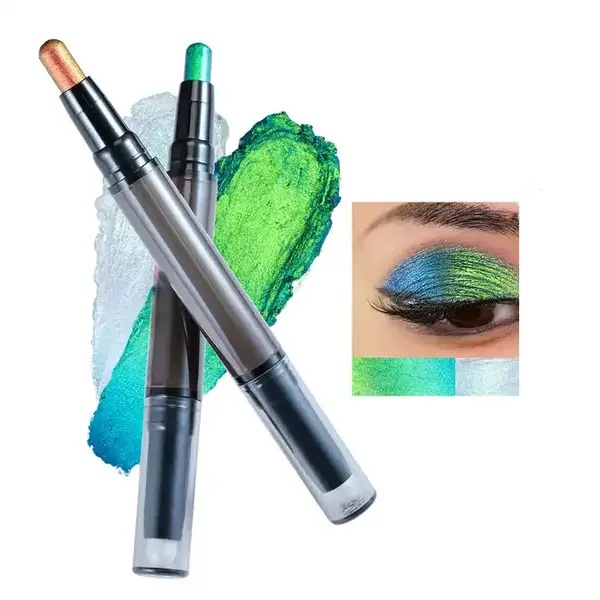
When a consumer shifts the viewing angle relative to the surface plane, $\sin^2 \theta$ increases, reducing the path length difference inside the dielectric layer. This shifts the reflected wave toward shorter wavelengths (hypsochromic shift, or ‘blue-shift’). A green-to-purple chameleon formulation transitions across the visual spectrum according to the incident angle:
| Viewing Angle ($\theta$) | Optical Path Length | Dominant Shift Peak ($\lambda$) | Perceived Dynamic Hue |
|---|---|---|---|
| Normal ($0^\circ$) | Maximum path length | $530,\text{nm} - 545,\text{nm}$ | Saturated Vivid Emerald |
| Oblique ($45^\circ$) | Intermediate path length | $480,\text{nm} - 495,\text{nm}$ | Cyan / Electric Peacock Blue |
| Grazing ($75^\circ$) | Minimum path length | $405,\text{nm} - 425,\text{nm}$ | Deep Violet / Amethyst Magenta |
Substrate Particle Size Distribution (PSD)
Optimum color purity requires controlling the Particle Size Distribution (PSD). For pressed eye powders, particle sizing directly dictates payoff creaminess and sparkle dispersion:
- $D_{10}$ Threshold: $\ge 15,\mu\text{m}$ (particles below $10,\mu\text{m}$ introduce light scattering, reducing color-travel saturation).
- $D_{50}$ Target: $35,\mu\text{m} \pm 3,\mu\text{m}$ (delivers maximum balance between color shift visibility and skin adhesion).
- $D_{90}$ Upper Cut: $\le 85,\mu\text{m}$ (prevents ocular grittiness and complies with cosmetic eye-area sensory guidelines).
2. Compounding Engineering: Binder Chemistry and Compaction Kinetics
Compounding multi-chrome pigments presents a persistent formulation challenge: synthetic silica substrates have minimal surface electrostatic charge and zero intrinsic plasticity, unlike natural talc or kaolin.
                  [POWDER BLENDING SEQUENCE]

    Dry Metal Soaps + Extenders (Zinc Stearate, Boron Nitride)
                             │
                             ▼ [High-Shear De-agglomeration: 1200 RPM, 3 min]
             Homogeneous Base Matrix
                             │
                             ▼ [Charge Fragile Multi-Chrome Silica Flakes]
         Low-Shear Ribbon Blending (< 35 RPM, 5 min)
                             │
                             ▼ [Atomized Liquid Binder Injection @ 2.5 bar]
        Hydrated Cake Granulate (Sieved through 40-mesh / 400 um screen)
                             │
                             ▼
      Pneumatic / Hydraulic Compacting Line (2-Stage Dwell)
The Failure Modes
- Drop-Shatter Failure (Friability > 1.5%): Caused by binder deficit ($< 7.0%,\text{w/w}$) or insufficient compaction pressure ($< 6.5,\text{MPa}$). Under mechanical impact, shear stress breaks the weak bonds between the rigid silica platelets, causing structural failure.
- Hardpan Glazing: Caused by excessive non-volatile lipid loads ($> 12.0%,\text{w/w}$) or excessive pressing force ($> 14.0,\text{MPa}$). The compaction force forces free lipids to migrate upward via capillary action. When the user touches the surface, skin sebum and lipids consolidate into an impermeable glaze that halts powder transfer.
Engineered Dual-Phase Binder System
To resolve this trade-off, our pilot production uses a dual-phase volatile/non-volatile liquid matrix combined with dry metallic soaps:
| Formulation Phase | Raw Material / INCI | Mass Ratio (% w/w) | Mechanical & Rheological Function |
|---|---|---|---|
| Dry Pre-Mix | Chameleon Flakes (Silica + Metal Oxides) | $78.0 - 84.0%$ | Core optical interference colorant ($D_{50} = 35,\mu\text{m}$). |
| Dry Pre-Mix | Zinc Stearate | $3.0 - 4.5%$ | Dry metallic soap lubricant; enhances inter-particle cohesion without crushing flakes. |
| Dry Pre-Mix | Boron Nitride (Spherical, $D_{50} = 6,\mu\text{m}$) | $2.0 - 3.5%$ | Ball-bearing dry slip agent; fills micro-voids between silica platelets to soften skin drag. |
| Wet Binder | Caprylic/Capric Triglyceride | $3.5 - 5.0%$ | Non-volatile lipophilic emollient; controls cushion, pay-off creaminess, and skin wettability. |
| Wet Binder | Dimethicone (and) Vinyl Dimethicone Crosspolymer | $2.0 - 3.0%$ | High-molecular-weight silicone elastomer; provides elastic recovery during drop impacts. |
| Wet Carrier | Isododecane (Volatile Solvent Carrier) | $3.0 - 5.0%$ | Low-viscosity carrier for binder atomization; evaporates completely post-pressing. |
Compaction Press Curve & Hydraulic Dynamics
Unlike standard high-speed eccentric mechanical presses, chameleon eyeshadow cakes require a gradual hydraulic ramp-down profile to de-aerate the powder matrix without fracturing platelets:
Pressure (MPa)
   10.0 ┼               ┌─────────┐  <- Peak Hold: 8.5 - 10.5 MPa (1.5 - 2.5 s)
    8.0 ┼              /           \
    6.0 ┼             /             \
    4.0 ┼      ┌─────┘               \  <- Controlled Decompression (< 2.0 MPa/s)
    2.0 ┼     / <- Stage 1: De-aeration (3.0 MPa, 1.8 s)
    0.0 ┼────┴─────────────────────────┴──────── Time (Seconds)
0 1 2 3 4 5 6 7- Pre-Compaction & De-aeration: Ramped to $2.5 - 3.5,\text{MPa}$ with a $1.5 - 2.0,\text{second}$ dwell. This exhausts air entrained between large surface area silica platelets through porous die tops (polyethylene mesh or sintered bronze plates), preventing internal pressure pockets that cause cake capping.
- Peak Compaction Hold: Ramped up to $8.5 - 10.5,\text{MPa}$ with a $2.0,\text{second}$ dwell to pack the lipid-coated platelets into an interlocking matrix.
- Controlled Decompression: Decompression speed is throttled to $< 2.0,\text{MPa/second}$. Instant pressure release creates an elastic rebound within the cross-linked silicone elastomer, causing micro-cleavage fractures across the cake face.
3. Pan Metallurgy and Magnetic Retention Standards
For indie launches prioritizing single magnetic pans or interchangeable palette wells, choice of pan metallurgy is a common operational failure point:
                 CROSS-SECTION: 26MM EYE PAN IN HOUSING WELL

       Porous Compaction Head
          │             │
          ▼             ▼
      ┌─────────────────────┐  <- Smooth, even cake surface
     │ [PRESSED POWDER CAKE] │
     │┌─────────────────────┐│
     └┤  SPTE Tinplate Pan  ├┘  <- Ribbed wall locks powder cake
      └─────────────────────┘
                 │
                 ▼ [Magnetic Flux Lines: B > 800 Gauss]
═══════════════════════ <- Permanent Neodymium / Ferrite Base Well- Aluminum (Al 1050/1060): Chemically resistant and lightweight, but non-ferromagnetic. Aluminum pans will not adhere to magnetic palettes without gluing secondary steel discs to their base, which adds labor and raises unit packaging costs.
- Tinplate (SPTE - Electrolytic Tin Coated Steel Sheet): Ferromagnetic, cost-effective, and fully compatible with magnetic palettes. We specify tinplate with a minimum thickness of $0.20 - 0.24,\text{mm}$ to prevent pan sidewall deflection under $10,\text{MPa}$ hydraulic loads.
- Wall Geometry: Pans must feature stepped, serrated, or ribbed sidewalls (horizontal draw-score profiling). Smooth-walled pans allow compacted powder cakes to rotate and release from the metal perimeter during transit vibration.
4. 100-Unit Batch Economics: Cost-of-Goods Breakdown
Below is an itemized cost analysis comparing a 100-unit single 26mm magnetic pan run with a 100-unit custom 4-pan palette. This model reflects landed, retail-ready deliverables manufactured under controlled-environment environment conditions:
| Itemized Production Cost Element | 100-Unit Single Pan (26mm / 1.5g net) | 100-Unit 4-Pan Palette (4 x 1.5g net) | Engineering & Sourcing Notes |
|---|---|---|---|
| High-Purity Chameleon Bulk | $2.40 | $8.60 | Synthetic silica base ($D_{50} = 35,\mu\text{m}$), CVD metal oxide layers. |
| Pan Hardware & Compaction Labor | $0.85 (Tinplate pan + PET blister) | $2.90 (4 pans + manual alignment) | Includes hydraulic dwell, mesh pressing cloth, and assembly labor. |
| Primary & Secondary Packaging | $0.65 (Printed envelope sleeve) | $3.50 (Rigid cardboard palette + mirror) | Low-run digital CMYK + matte lamination + spot UV/foil. |
| Lot Release QA & ICP-MS Testing | $0.50 (Allocated lot charge) | $0.90 (Allocated lot charge) | Agilent 7800 ICP-MS screen (Pb, As, Cd, Hg, Sb) COA per batch. |
| Protective Thermoform Transit Case | $0.25 | $0.60 | Custom high-density EPE foam tray to isolate shear shock. |
| Air Express Shipping (DDP terms) | $1.15 | $2.40 | Courier door-to-door (5–7 business days transit). |
| Total Landed Unit Cost (DDP) | $5.80 / unit | $18.90 / unit | Fully assembled, packaged, and labeled retail SKU. |
| Benchmark Direct-to-Consumer MSRP | $22.00 - $26.00 | $58.00 - $68.00 | Standard indie pricing for ultra-premium multi-chromes. |
| Gross Profit Margin per Unit | 74.8% – 77.7% ($17.20+) | 67.4% – 72.2% ($39.10+) | Sustains paid digital acquisition or retail margin splits. |
Note on Pan Tooling Charges: Standard 26mm circular, 27mm square, and 22x40mm rectangular dies are pre-tooled in-house. Custom geometric configurations (e.g., custom cast-metal pans, debossed logo punches) incur a one-time CNC wire-EDM tooling fee of $280 to $450.
5. Regulatory Compliance & Global Safety Standards
+---------------------------------------------------------------------------------------------------+
|  REGULATORY ADVISORY & STATUTORY COMPLIANCE BOUNDARIES                                            |
|  The United States FDA does not certify, register, or pre-approve private cosmetic manufacturing  |
|  facilities or individual cosmetic SKUs. Facility compliance under MoCRA Section 607 and product  |
|  listings under Section 608 represent legal registrations executed by the Brand/Manufacturer      |
|  and do not constitute agency endorsement. Finished product safety remain the legal               |
|  responsibility of the Brand Owner via pilot line mechanical and toxicological substantiation.    |
+---------------------------------------------------------------------------------------------------+
Eye-area colorants must comply with stringent cosmetic ingredient standards. Contamination or off-list colorants can trigger product seizures, regulatory fines, and brand liability.
1. FDA 21 CFR Color Additive Permissibility (United States)
Every inorganic batch constituent must comply with 21 CFR Chapter I, Subchapter A, Part 73 (Color Additives Exempt from Certification):
- Synthetic Fluorphlogopite (21 CFR § 73.2995): Cleared for general cosmetic use, including the eye area.
- Silica: Permitted safe carrier and bulking constituent.
- Titanium Dioxide (21 CFR § 73.2575): Permitted for eye-area use; must test negative for antimony and satisfy USP specifications.
- Iron Oxides (21 CFR § 73.2250): Fully cleared for eye cosmetics.
- Ferric Ferrocyanide (CI 77510 / 21 CFR § 73.2299): Permitted in eye cosmetics; prohibited in lip formulations.
- CRITICAL RESTRICTION: Aromatic organic lake dyes including D&C Red No. 6 Lake, Red No. 7 Lake, and Red No. 27 Lake are strictly prohibited from eye-area cosmetics under U.S. FDA regulations due to mucous membrane reactivity. Chameleon formulations shifting into magenta/rose-gold must utilize exclusively approved inorganic Iron Oxides, Manganese Violet (CI 77742), or Carmine (CI 75470—must be disclosed for vegan marketing).
2. EU Regulation (EC) No 1223/2009 & Microplastic Audits
- Annex IV Positive List: All utilized colorants hold verified Annex IV listings with corresponding CI numbers.
- Commission Regulation (EU) 2023/2055 (Microplastic Restrictions): Inorganic chameleon pigments based on synthetic silica, synthetic fluorphlogopite, and mineral metal oxides are pure mineral substances exempt from microplastic bans. However, brands must review secondary binder components: dimethicone polymers must have their solubility and degradation profiles verified by the downstream EU Responsible Person (RP) to confirm they do not trigger solid synthetic polymer micro-particle restrictions.
3. Trace Element Limits via Agilent 7800 ICP-MS
Every production lot is subjected to closed-vessel microwave-assisted acid digestion (EPA Method 3052) followed by Inductively Coupled Plasma Mass Spectrometry (ICP-MS) analysis. Finished powder batches must clear internal release thresholds and international standards:
Heavy Metal Detection - Agilent 7800 ICP-MS Limits of Detection (LOD < 0.01 ppm):
├── Lead (Pb):         Release Spec < 2.0 ppm  (Industry benchmark < 10.0 ppm)
├── Arsenic (As):       Release Spec < 1.0 ppm  (Industry benchmark < 3.0 ppm)
├── Cadmium (Cd):       Release Spec < 0.5 ppm  (Industry benchmark < 1.0 ppm)
├── Mercury (Hg):       Release Spec < 0.1 ppm  (Industry benchmark < 1.0 ppm)
└── Antimony (Sb):      Release Spec < 1.0 ppm  (Industry benchmark < 5.0 ppm)
6. Pilot-to-Production Quality Assurance Protocols
To ensure low-MOQ pressed pans survive fulfillment centers and domestic courier transits, our production process utilizes three mechanical screening procedures:
              MECHANICAL STABILITY RELEASE PROTOCOL

    [Finished Pressed Lot (100 - 300 units)]
                     │
                     ▼
    ┌────────────────────────────────────────────────────────┐
    │ 1. Friability Impact Testing (ASTM D5276 Baseline)     │
    │    • 3 consecutive drops from 30 cm onto solid oak     │
    │    • Pass Criteria: Net mass loss < 1.00% w/w          │
    ├────────────────────────────────────────────────────────┤
    │ 2. Hardpan Penetration Penetrometry                     │
    │    • 10 mechanical cycles with simulated PU finger-pad │
    │    • Pass Criteria: Payoff variation < 8.0% across run │
    ├────────────────────────────────────────────────────────┤
    │ 3. Magnetic Retention Pull Verification                │
    │    • Minimum vertical retention force >= 1.2 N         │
    └────────────────────────────────────────────────────────┘
                     │
                     ▼
[Certificate of Analysis (COA) Sign-Off & Packaging Release]- Drop Friability Test (ASTM D5276 Modified): Three finished pans from every 100-unit pilot run are dropped freely from a height of $30,\text{cm}$ ($12,\text{inches}$) through a guiding tube onto a $50,\text{mm}$ thick solid oak block. The pan is weighed on an analytical balance before and after the drop series. Total powder cake mass loss must not exceed $1.0%,\text{w/w}$, with zero structural edge cracking.
- Surface Hardpan Penetration Test: A standardized polyurethane finger-pad probe (durometer 30 Shore A, mimicking human dermal compliance) rotates over the cake surface across 10 cycles under $1.5,\text{N}$ downforce. Payoff mass is measured to ensure the cake does not form an impermeable lipid glaze.
- Magnetic Pull Force Verification: Magnetic tinplate pans are evaluated on a digital force gauge to confirm a minimum vertical release retention force of $\ge 1.2,\text{N}$ against a standard rubber-ferrite magnetic sheet.
7. 30-Day Launch Roadmap (100-Unit Turnkey Execution)
flowchart TD
    A[Day 1-5: Shade Selection & Fast Sampling] -->|Dispatch 3-Shade Pilot Lab Kit| B[Day 6-12: Client Evaluation & Wear Testing]
    B -->|Formula Sign-Off & Artwork Files| C[Day 13-20: Compounding & Hydraulic Pressing]
    C -->|Compacted Pans & Finished Assemblies| D[Day 21-25: ICP-MS Testing & Friability QA]
D -->|COA Generation & DDP Courier Packaging| E[Day 26-30: Direct Air Delivery to Brand Hub]- Phase 1: Lab Sampling (Days 1–5): Select up to 3 target color-travel paths from our library of 80+ developed chameleon formulas (e.g., Bronze-Gold-Olive, Cyan-Blue-Violet, Emerald-Teal-Amethyst), or submit a competitive physical sample for spectrophotometric matching. Custom pressed lab prototypes are pressed and dispatched via air express within 3 to 5 business days.
- Phase 2: Client Wear Testing & Primary Artwork Sign-Off (Days 6–12): Your product team evaluates payoff saturation, finger pick-up, crease resistance (8-to-12 hour baseline), and palette housing compatibility. Final vector artwork for unit cartons, magnetic base labels, or custom palettes is approved.
- Phase 3: Controlled Suite Compounding & Compacting (Days 13–20): Formulations are compounded in ISO Class 7 (Class 10,000) controlled-environment suites. Powder mixes are blended at low shear, atomized with the dual-phase binder matrix, and pressed on hydraulic pilot lines running the verified de-aeration dwell curves.
- Phase 4: Laboratory Quality Assurance Release (Days 21–25): Samples undergo drop-tower friability tests, penetrometer payoff validation, and microwave-digestion ICP-MS trace metal verification. A lot-specific Certificate of Analysis (COA) is generated alongside an ingredients declaration deck for your MoCRA Section 608 safety dossier.
- Phase 5: Secure Export & DDP Delivery (Days 26–30): Compacted units are packed in custom high-density protective EPE foam matrix trays, vacuum-sealed with desiccant packs to maintain dry-weight integrity, and dispatched via priority DDP air courier straight to your warehouse or third-party fulfillment center.
Technical FAQ for Indie Cosmetic Founders
Why do chameleon eyeshadows cost significantly more per gram than standard mica pearls?
Standard pearlescent pigments use natural mined mica coated with a single layer of titanium dioxide, produced via simple precipitation in high-volume tanks. Chameleon multi-chromes require synthetic, atomically smooth silica or borosilicate flake substrates coated via precision chemical vapor deposition (CVD). The optical dielectric layers must be monitored in real time down to nanometer tolerances. Any structural thickness variance beyond $\pm 2.0,\text{nm}$ ruins the destructive wave cancellation required for clean color travel, which reduces industrial yields.
How does MLM Glitter avoid hardpan glazing on 100-unit small batch runs?
Most small-batch indie presses use high levels of non-volatile oils to compensate for low mechanical press power, which guarantees surface hardpan over time. We use custom single-cavity pneumatic/hydraulic presses operating at $8.5,\text{MPa}$ combined with a volatile Isododecane carrier phase. The Isododecane provides the required wetting lubrication during compaction, then evaporates during post-compaction curing, leaving an optimal non-volatile binder content of just $5.5% - 8.0%,\text{w/w}$.
Can I utilize aluminum pans instead of tinplate to cut costs?
Aluminum pans are inexpensive and rust-proof, but they are completely non-magnetic. If your product is sold as a replacement single pan or intended for a universal magnetic palette, aluminum will not work without an added ferromagnetic steel sticker on the bottom. We recommend SPTE electrolytic tinplate pans ($0.22,\text{mm}$ gauge) with ribbed walls: they couple directly to magnetic palettes and resist sidewall buckling during compaction.
What specific support documentation is provided for my MoCRA safety file?
Every commercial production lot from MLM Glitter includes a comprehensive Batch Dossier: lot-specific heavy metal ICP-MS analytical reports, microscopic flake morphology confirmation, raw material Safety Data Sheets (SDS) matching 21 CFR specifications, and quantitative INCI formula declarations to support your qualified safety assessor in filing MoCRA Section 607/608 documentation.