
Mandatory Regulatory & Quality Governance Notice
REGULATORY NOTICE & BOUNDARY DEFINITIONS: Under the U.S. Federal Food, Drug, and Cosmetic Act (FD&C Act) as amended by the Modernization of Cosmetics Regulation Act of 2022 (MoCRA), the U.S. FDA does not issue certifications, approvals, or licenses for finished cosmetic products, formulations, or contract manufacturing facilities. Compliance requires factory facility registration (MoCRA Section 607), product ingredient listing, and documented safety substantiation dossiers (MoCRA Section 608) maintained in facility archives. While MLM Glitter operates modern controlled-environment compounding suites and validates raw materials and pilot lots, every brand owner must validate finished container-closure compatibility and execute 12-week accelerated stability protocols ($45^\circ\text{C}$ / 75% RH) on their designated production packaging before retail distribution.
1. Atomization Fluid Mechanics: Eliminating Spitting & Orifice Crusting
In cosmetic spray applications, consumer perception of ‘luxury’ correlates directly with droplet uniformity. The failure mode known as “spitting” occurs when fluid pressure at the orifice drops below the threshold required to overcome the liquid’s surface tension, resulting in Rayleigh jet breakup instead of sheet atomization. Large droplets ($> 150,\mu\text{m}$) deposit excessive localized water volume, dissolving foundation pigments and causing pigment pooling.
Fluid Pressurization via Pre-Compression Stroke (P ≥ 0.35 MPa)
                         │
                         ▼
  [Dual Tangential Swirl Channels: Angular Momentum Generation]
                         │
                         ▼ [Laser-Drilled Micro-Orifice: 0.12–0.14 mm]
  [Annular Liquid Sheet Breakup: Aerodynamic Shear (We ≥ 40)]
                         │
                         ▼
  [Homogeneous Micro-Mist Plume: Sauter Mean Diameter D32 ≤ 45 µm]
       (Complete Evaporative Thin-Film Cure: 18–25 Seconds)
The fluid mechanics of the spray plume are governed by the Weber number ($We$), comparing fluid inertia to surface tension forces:
$$We = \frac{\rho_a \cdot v_{\text{rel}}^2 \cdot d_0}{\sigma}$$
Where:
- $\rho_a$ = Ambient air density ($1.204,\text{kg/m}^3$ at $20^\circ\text{C}$)
- $v_{\text{rel}}$ = Velocity of fluid exiting the nozzle orifice (typically $18\text{–}24,\text{m/s}$ in calibrated pre-compression pumps)
- $d_0$ = Orifice diameter ($0.12\text{–}0.14,\text{mm}$)
- $\sigma$ = Dynamic liquid surface tension ($27.0\text{–}31.5,\text{mN/m}$)
To prevent the ejection of un-atomized droplets at the start and completion of each actuation, our engineering desk pairs formulations exclusively with mechanical pre-compression actuators. A internal spring-loaded elastomer stem remains hermetically closed until chamber pressure hits $\ge 0.35,\text{MPa}$. This eliminates low-velocity dribble during trigger take-up and release.
Droplet Distribution: Standard Pumps vs. MLM Engineered Micro-Mist
Using our Malvern Spraytec laser diffraction system at a $15,\text{cm}$ target distance, droplet populations show clear divergence between standard stock pumps and our micro-orifice actuators:
- Off-the-shelf standard finger pumps: $D_{32} = 135\text{–}240,\mu\text{m}$, $D_{90} > 380,\mu\text{m}$. Heavy localized fluid deposition leads to running, blotchiness, and drying times exceeding 70 seconds.
- MLM Glitter Micro-Mist Actuator: Sauter Mean Diameter $D_{32} \le 45,\mu\text{m}$, with a narrow span: $D_{90} < 75,\mu\text{m}$ and $D_{10} > 18,\mu\text{m}$. Droplets coalesce into a uniform monomolecular layer, flash-evaporating in 18 to 25 seconds at $21^\circ\text{C}$ and 50% relative humidity.
2. Formulation Chemistry: Polymer Film Integrity & Rheological Windows
A resilient setting spray must yield a continuous, flexible film that resists trans-epidermal sebum and environmental moisture without producing skin tightness or plasticizer migration.
[Compounding Flow Architecture: Class 100,000 Controlled-Environment]

De-ionized Water (Conductivity < 1.0 µS/cm via Reverse Osmosis + EDI)
                           │
                           ▼
[Phase A: Low-Shear Hydration Tank @ 450 RPM, 35°C]
  AMP-Acrylates/Allyl Methacrylate Copolymer (2.80% w/w)
  + Polyglyceryl-4 Caprate Surface Tension Reducer (0.60% w/w)
                           │
                           ▼
[Phase B: Secondary Polymer Integration @ 250 RPM]
  Polyurethane-35 (1.40% w/w) + Betaine Osmolyte (0.80% w/w)
                           │
                           ▼
[Phase C: Preservative & Chelating System]
  Phenoxyethanol (0.80%) + Ethylhexylglycerin (0.10%) + Sodium Phytate (0.05%)
                           │
                           ▼
[Dual In-Line 5-Micron Polypropylene Depth Filtration]
                           │
                           ▼
[Filling Line Piston Dispenser: Calibrated Torque Capping 1.6–1.8 N·m]
The Engineered Polymer Matrix
- High-Tenacity Film Former (AMP-Acrylates/Allyl Methacrylate Copolymer, 2.5% – 3.5% w/w): Delivers hydrophobic cross-linking that repels perspiration while exhibiting low tackiness once cured.
- Flexibility Plasticizer (Polyurethane-35, 1.0% – 1.8% w/w): Imparts structural elasticity. Prevents tensile micro-cracking across facial expression lines (nasolabial folds and periocular zones).
- Anti-Crusting Meniscus Modifiers (Betaine + Butylene Glycol, 1.0% – 2.0% w/w): Maintains hydration of the fluid meniscus inside the internal nozzle swirl chamber, preventing solid polymer film crusting over 60-day idle periods.
Formulation Specifications for Continuous Atomization
| Technical Parameter | Specification Window | Testing Method / Plant Protocol | Formulation Consequence if Out of Spec |
|---|---|---|---|
| Dynamic Viscosity ($\mu$) | $8.5\text{–}14.5,\text{mPa}\cdot\text{s}$ | Brookfield LVDV-II+ (UL Adapter, $60,\text{RPM}, 25^\circ\text{C}$) | $> 15.0,\text{mPa}\cdot\text{s}$ yields jetting/stringing; $< 7.5,\text{mPa}\cdot\text{s}$ increases droplet diameter. |
| Surface Tension ($\sigma$) | $27.0\text{–}31.5,\text{mN/m}$ | Krüss Wilhelmy Plate Tensiometer ($22^\circ\text{C}$) | $> 33.0,\text{mN/m}$ prevents sheet thinning; $< 25.0,\text{mN/m}$ induces foaming and seal seepage. |
| Specific Gravity | $0.990\text{–}1.015,\text{g/cm}^3$ | Anton Paar DMA 35 Digital Density Meter | Deviations indicate air entrainment or batch weighing variance. |
| pH Range | $5.40\text{–}6.20$ | Mettler Toledo SevenDirect ($25^\circ\text{C}$) | $< 5.20$ risks polymer precipitation; $> 6.50$ compromises organic preservative efficacy. |
| Preservation System | Pass USP $\langle 51\rangle$ / ISO 11930 | 28-day challenge against bacteria, yeast, and mold | Assures 3-year shelf-life stability in non-pressurized packaging. |
3. Suspended Shimmer & Duochrome Engineering: Non-Clogging Particle Physics
Formulating luminous or color-shifting duochrome setting sprays presents severe rheological challenges. Conventional effect pigments settle into dense cakes over time, which will lock up dip-tube valves and permanently plug actuator orifices.
[Anti-Sedimentation / Anti-Clog Dip-Tube Assembly]

         ┌─────────────────────────┐
         │ 0.12–0.14 mm Laser Cut  │ <── Actuator Orifice
         │ Swirl Nozzle Chamber    │
         └───────────┬─────────────┘
                     │
            [Pre-Compression Stem]
            (FKM / EPDM Gasket Seal)
                     │
         ┌───────────┴─────────────┐
         │ Thick-Wall Dip Tube     │ (ID: 1.8 mm, OD: 2.6 mm to prevent
         │ (Stress-Crack Resistant)│  shear-induced fluid cavitations)
         └───────────┬─────────────┘
                     │
         ┌───────────┴─────────────┐
         │ 120-Mesh (125 µm) Filter│ <── Physical Barrier Blocks Flake
         │ Stainless Steel Screen  │     Agglomerates
         └─────────────────────────┘
                     │
  [Rheological Carrier: Yield Stress τ₀ ≥ 0.05 Pa, Synthetic Fluorphlogopite D50 ≤ 20 µm]
Pigment Substrate & Size Distribution Rules
- Synthetic Fluorphlogopite & Borosilicates Only: Natural micas exhibit jagged edge fracture planes and broad platelet distribution ($> 60,\mu\text{m}$) that jam actuator chambers. We formulate exclusively with synthetic fluorphlogopite substrates screened to $D_{50} \le 20,\mu\text{m}$ ($D_{90} < 35,\mu\text{m}$). Platelet thickness is maintained under $350,\text{nm}$ to optimize optical interference without adding physical bulk.
- Pseudoplastic Yield-Stress Suspension Matrix: We incorporate low-acyl gellan gum ($0.06\text{–}0.10%,\text{w/w}$) or an optimized crosslinked acrylate network to establish a rest yield stress ($\tau_0 \ge 0.05,\text{Pa}$). This network holds micro-shimmer in suspension indefinitely at rest, yet thins to under $13.5,\text{mPa}\cdot\text{s}$ under the shear of the pump stroke.
- Mechanical In-Line Dip Filtration: Dip tubes on all shimmer SKUs are fitted with an ultrasonic-welded 120-mesh ($125,\mu\text{m}$) 316 stainless-steel intake cage. This provides a physical fail-safe, preventing dried agglomerates from ever reaching the pre-compression chamber.
4. Packaging Mechanics: Eco-Continuous Compression vs. Fine-Mist Pumps
Indie brands targeting clean beauty channels must avoid aerosolized propellants (e.g., isobutane, propane, HFC-152a). Pressurized canisters trigger strict California Air Resources Board (CARB) Consumer Product VOC regulations ($< 6.0%,\text{VOC}$ threshold) and introduce expensive Hazmat class 2.1 shipping classifications.
| Engineering Attribute | Eco-Continuous Mechanical Sprayer | Finger-Actuated Fine-Mist Pump (50ml / 100ml) |
|---|---|---|
| Operating Mechanism | Dual-chamber mechanical compression engine | Single-stroke pre-compression piston |
| Plume Profile | Continuous mist ($1.15\text{–}1.25,\text{ml/sec}$) | Pulse mist ($0.12\text{–}0.15,\text{ml}$ per actuation) |
| Propellant Requirement | Zero VOC / 100% Propellant-Free | Zero VOC / 100% Propellant-Free |
| CARB VOC Compliance | Compliant: Non-aerosol cosmetic specification | Compliant: Non-aerosol cosmetic specification |
| Hazmat Surcharge | None (Standard freight classification) | None (Standard freight classification) |
| Internal Gasket Polymer | Fluoroelastomer (FKM) / Food-Grade Silicone | Peroxide-Cured EPDM / Low-Density Polyethylene |
| Closure Capping Torque | $1.6\text{–}1.8,\text{N}\cdot\text{m}$ (Bayonet / Threaded) | $1.4\text{–}1.6,\text{N}\cdot\text{m}$ (20/410, 24/410 neck) |
| Vacuum Integrity Testing | Passes $-0.06,\text{MPa}$ for 30 min (ASTM D4991) | Passes $-0.06,\text{MPa}$ for 30 min (ASTM D4991) |
5. Turnkey Unit Economics for Indie Brands: 100 pcs vs. 1,000 pcs
Traditional contract packagers enforce high minimum thresholds of 5,000 to 10,000 units per formulation. At MLM Glitter, our flexible controlled-environment lines support low-volume production runs starting at 100 to 300 units, lowering capital exposure while validating commercial traction.
| Production Cost Factor | 100-Unit Pilot Batch (Unit Cost) | 1,000-Unit Commercial Batch (Unit Cost) | Factory Execution Details |
|---|---|---|---|
| Bulk Finished Formulation (100ml Liquid) | $2.20 | $1.35 | Triple-filtered, EDI water base, AMP/PU film formers, active humectants. |
| Primary Packaging & Precision Actuator | $1.75 | $0.95 | Heavy-wall PET or frosted glass bottle, metal-sheathed $0.12,\text{mm}$ pump. |
| Secondary Box & Bottle Decoration | $0.85 | $0.40 | Short-run CMYK + cold-foil unit carton; 1-color UV silk screen on primary container. |
| Batch Release COA Testing & QC | $0.80 | $0.12 | Amortized ICP-MS heavy metals testing and 48-hr bio-burden incubation. |
| DDP Air Courier Logistics (Factory to Brand) | $2.20 | $1.20 | Direct Door-to-Door air transit including customs clearance and duties. |
| Total Landed Unit Cost (DDP) | $7.80 | $4.02 | Ready-for-sale inventory delivered to your fulfillment facility. |
| Target Retail Benchmark (MSRP) | $28.00 | $28.00 | Aligned with prestige retail benchmarks (e.g., Urban Decay, Charlotte Tilbury). |
| Gross Profit Margin (%) | 72.1% ($20.20 unit margin) | 85.6% ($23.98 unit margin) | Sufficient margin depth for customer acquisition costs (CAC) and influencer seeding. |
Initial Working Capital Requirements: Launching a verified 100-unit pilot run requires $780 in inventory production, alongside our $300 custom formulation prototyping fee (which is 100% credited back toward your commercial purchase order). Brand owners can launch a fully tested setting spray SKU for under $2,000 in total initial working capital.
6. Analytical Release Testing & Regulatory Compliance Files
[Finished Production Compounding Batch]
                     │
                     ▼
[Microwave Acid Digestion: EPA Method 3052 (Closed Vessel)]
                     │
                     ▼
[Agilent 7800 ICP-MS Quantitative Heavy Metal Screening]
  ├── Lead (Pb): < 1.0 ppm     ├── Cadmium (Cd): < 0.3 ppm
  ├── Arsenic (As): < 0.5 ppm  └── Mercury (Hg): < 0.1 ppm
                     │
                     ▼
[Microbiological Release: USP <51> / USP <61>/<62> (ISO 21149)]
  └── Total Aerobic Microbial Count < 100 CFU/g | Pathogen Screening: Absence
                     │
                     ▼
[Physical Integrity & Seal Testing: ASTM D4991 Vacuum Hold @ -0.06 MPa]
                     │
                     ▼
[Comprehensive COA Issued + MoCRA Section 607/608 Dossier Export]
Every production lot manufactured at MLM Glitter undergoes release screening documented on an authorized Certificate of Analysis (COA):
1. Heavy Metal Quantitation via Agilent 7800 ICP-MS
Raw pigments, water streams, and botanical fractions undergo microwave-assisted acid digestion (EPA 3052) followed by inductively coupled plasma mass spectrometry:
- Lead ($\text{Pb}$): $< 1.0,\text{ppm}$ (Well below U.S. FDA 10 ppm guidance)
- Arsenic ($\text{As}$): $< 0.5,\text{ppm}$ (U.S. FDA limit: 3 ppm)
- Cadmium ($\text{Cd}$): $< 0.3,\text{ppm}$
- Mercury ($\text{Hg}$): $< 0.1,\text{ppm}$ (U.S. FDA limit: 1 ppm)
- Antimony ($\text{Sb}$): $< 0.5,\text{ppm}$
2. Regulatory Compliance Infrastructure
- U.S. MoCRA Section 607/608 Support: We supply fully quantified Quantitative Ingredient Declarations (QID), GHS-compliant Safety Data Sheets (16 CFR 1910.1200), and toxicological risk reviews for straightforward submission to the FDA Cosmetics Direct portal.
- Color Additive Compliance: For tinted or shimmer variants, all colorants comply with U.S. FDA 21 CFR Part 73/74 batch certifications and EU Cosmetic Regulation (EC) No 1223/2009 Annex IV restrictions.
- Health Canada & EU CPNP Documentation: In-house regulatory specialists supply complete Cosmetic Notification Forms (CNF) and technical Product Information File (PIF) dossiers formatted for EU/UK Responsible Persons.
7. 30-Day Turnkey Production Lifecycle: Bench Sample to Fulfillment
gantt
    title 30-Day Turnkey Setting Spray Production Schedule
    dateFormat  YYYY-MM-DD
    section Lab Prototyping
    Formulation Tuning & Fragrance Blending :a1, 2026-11-01, 5d
    Air Express Prototype Dispatch          :a2, after a1, 3d
    section Validation & Component QA
    Client Mist Angle & Wear Validation     :b1, after a2, 3d
    Torque Calibration & ASTM D4991 Vacuum  :b2, after b1, 3d
    section Commercial Batch Production
    EDI Water Compounding & Polymer Hydration :c1, after b2, 5d
    Semi-Automated Filling Line:c2, after c1, 4d
    section Release & Door-to-Door Delivery
    ICP-MS & 48-Hour Micro Plate Clearance  :d1, after c2, 3d
DDP Air Express Courier Shipping :d2, after d1, 5d- Days 1–7 (Custom Lab Formulation & Express Dispatch): You select base performance parameters (Matte Oil-Control, Dewy Glow, or Suspended Duochrome Shimmer). Our formulation chemists compound three customized 50ml lab-bench samples, shipping them via air express within 3 to 7 working days. The $300 prototyping fee is credited to your commercial PO.
- Days 8–14 (Actuator Evaluation & Torque Profiling): You evaluate dry time, mist plume diameter, and wear longevity over makeup. Simultaneously, packaging components undergo torque optimization ($1.6\text{–}1.8,\text{N}\cdot\text{m}$) and 24-hour vacuum testing at $-0.06,\text{MPa}$ (ASTM D4991).
- Days 15–22 (Bulk Compounding & Controlled-Environment Filling): Formulations are blended in 316L stainless-steel jacketed vessels using low-shear cowles dissolution. Primary containers are de-ionized air-cleaned, volumetrically filled, and capped on semi-automated lines within our controlled-environment compounding facility.
- Days 23–30 (Analytical Clearance & DDP Logistics): Microbial incubation and ICP-MS testing are completed within 72 hours. Upon batch sign-off and COA generation, finished cartons are dispatched via DDP air express straight to your fulfillment center.
Technical FAQ
What are the standard minimum order quantities (MOQ) for custom formulas vs. custom packaging?
Our pilot line minimum is 100 units for catalog packaging (in-stock bottles and pre-compression micro-pumps) and 300 units for custom-decorated primary packaging (such as custom silk screening or UV lacquer finishes). This allows founders to bring custom formulations to market without high inventory risk.
How does the formulation prevent nozzle clogging over multi-week consumer use?
We formulate with a dual anti-crusting mechanism: secondary humectants (Betaine and Butylene Glycol) prevent the water meniscus inside the nozzle swirl chamber from evaporating completely. Coupled with our pre-compression shut-off valve, the fluid column stays hydrated for up to 60 days between actuations without forming an insoluble polymer plug.
How does the bespoke lab sampling credit work?
Our bench prototype kit costs a flat $300 and includes three distinct aesthetic or functional adjustments delivered via express air courier. Once you approve the Master Sample and issue a production order for 100+ units, the $300 fee is credited in full against your commercial invoice.
Can duochrome pigments and cosmetic glitters be suspended without clogging micro-mist pumps?
Yes. We employ synthetic fluorphlogopite effect pigments milled and classified to $D_{50} \le 20,\mu\text{m}$, stabilized within a pseudoplastic gellan gum matrix (yield stress $\tau_0 \ge 0.05,\text{Pa}$). The formulation flows freely under the shear of the pump stroke and passes cleanly through our integrated 120-mesh ($125,\mu\text{m}$) dip-tube filter screens without clogging.
Request Your 3-Piece Setting Spray Lab Sample Kit
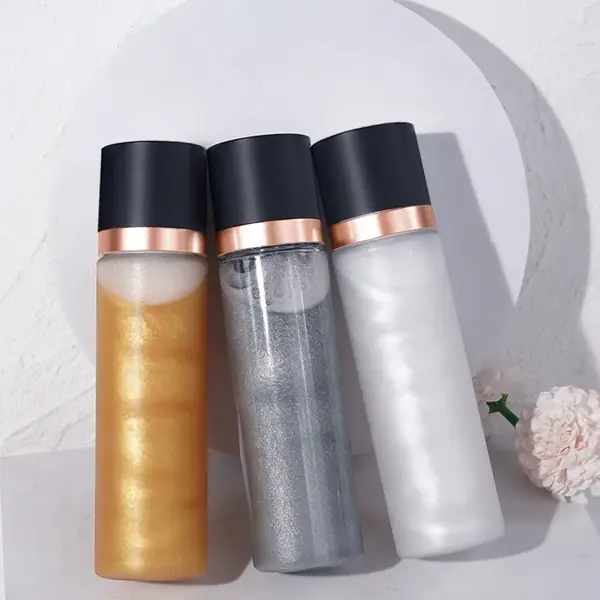
Ready to manufacture a reliable, high-tenacity setting spray with smooth micro-mist atomization? Request our Indie Brand Prototyping Kit—featuring Matte Oil-Control, Dewy Glow, and Pearlescent Shimmer bench samples formulated to your specifications. Connect with our engineering and regulatory desk in Shenzhen to begin your 3-day sample dispatch.