
Competitive Gap Analysis
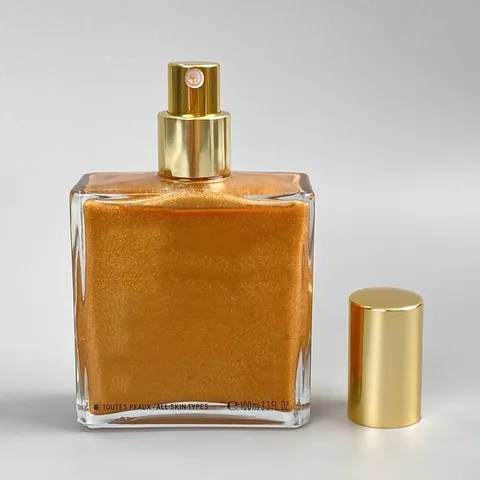
A private label shimmer body oil supplier should validate the pigment, dry-down profile, and dispenser as one system before a buyer commits to bulk production.
- Suspension stability is more than a viscosity reading. Supplier listings rarely explain how low-shear structure, mica agglomeration, and storage temperature affect settling. A finished oil can look uniform at filling and still develop a compact sediment that consumers cannot redisperse.
- Fast dry-down is not the same as low clothing transfer. Lightweight carriers can reduce the oily feel after application, but neither a dry-touch finish nor a volatile carrier guarantees that oil or pearl will stay off fabric. Buyers need separate dry-down and transfer tests.
- Glitter compliance depends on particle composition, not marketing terminology. Mineral mica, polymer-coated mica, PET glitter, and cellulose-based shimmer require different documentation. A claim such as “biodegradable glitter” cannot substitute for a materials review under the EU microplastics restriction.
- Nominal nozzle diameter does not establish package compatibility. A 0.12–0.15 mm passage measures 120–150 µm, smaller than the upper end of a 200 µm mica specification. Even finer mica can clog a dispenser if flakes agglomerate or pigment accumulates in the valve or dip tube.
Key Facts at a Glance
MLM Glitter supplies private label shimmer body oil directly from Shenzhen, China, with orders starting at 100 pieces per shade.
- 100 pieces per shade: Starting private label MOQ; confirm any separate bottle, closure, decoration, or carton minimums before quoting a multi-shade launch.
- 10–200 µm: Custom cosmetic-grade mica range for shade development; the approved particle-size distribution depends on the visual brief and dispenser.
- 3–7 business days: Lab sample dispatch window; transit time and additional revision rounds are separate.
- 25–35 days: Bulk production turnaround; confirm the production start date and approval milestones in the order terms.
- Sample fee credit: Lab sample fees are credited against bulk production orders; ask for the credit to appear on the quotation.
- 3-piece sample kit brief: Buyers can request viscosity swatches and specify California Proposition 65–related heavy-metal documentation needs during qualification.
- 3 core document types: MSDS/SDS, certificate of analysis (COA), and complete ingredient lists are provided on qualified commercial inquiry. Applicable test reports are also provided on qualified commercial inquiry, subject to the agreed test scope and availability.
Private Label Formulation Guide: Dry-Down, Mica, and Dispensing
A fast-drying shimmer body oil should be specified by measured after-feel, clothing transfer, and dispensing performance—not by the carrier name alone.
Choose the carrier for dry-down and fabric contact
A lightweight carrier system can produce a quick-absorbing feel without relying on a “non-transfer” claim. Volatile isododecane can shorten the wet phase through evaporation, while hemisqualane can improve spread and reduce heavy after-feel. These ingredients perform different functions: a quick-absorbing sensory impression does not establish how much oil or mica remains available to transfer.
Ask MLM Glitter to compare prototypes at a fixed application dose and defined intervals. Compare oil marks and visible pearl pickup separately on light and dark fabrics, with the fabric type and contact conditions recorded. Brands positioning a dry body oil for use before dressing should approve a specific transfer benchmark against the intended use rather than relying on a “won’t stain clothes” claim. See the body oil catalog for related dry-touch and fragrance-led formats.
Specify the particle distribution and suspension target
Mica particle distribution and low-shear structure determine whether a shimmer oil retains an even appearance or requires shaking before use. Finer pearls generally produce a softer sheen, while coarser flakes can create more visible sparkle. The coarse end of the distribution deserves particular attention because larger particles tend to settle faster under comparable conditions. Flake shape, density difference, and agglomeration also affect the result.
Silica dimethyl silylate or stearalkonium hectorite can help build structure in compatible oil systems. The procurement target is not simply a thicker oil: the formula needs enough structure at rest to slow settling while remaining easy to dispense and spread. Ask for viscosity measured at an agreed temperature and method, plus a separate redispersion check after storage. The private label shimmer body oil development brief should record the approved pearl loading by weight, particle distribution, and any shake-before-use requirement.
Qualify the complete dispenser assembly
A dispenser should be approved with filled product in the final bottle, not from an orifice drawing or an empty-package sample. A fine-mist format generally calls for tighter control of particle size and agglomeration than a treatment pump or controlled-pour closure. Coarser shimmer may suit a wider-flow package, but a larger outlet does not rule out blockage elsewhere in the assembly.
A packaging qualification plan should cover priming, dose consistency, upright storage, restart after idle periods, and residue at the outlet. For mist formats, add spray-pattern evaluation and review inhalation exposure under the intended use. Test the dip tube, valve, and outlet together before approving bulk components.
Specification Comparison Table
The fastest sourcing route is an existing base with qualified packaging, while a custom shimmer or mist format calls for additional formula and dispenser validation.
| Procurement parameter | Private label: existing base | OEM: custom dry-touch shimmer | ODM: dispenser-led development |
|---|---|---|---|
| Starting MOQ | 100 pieces per shade | 100-piece entry MOQ; confirm custom material and component minimums | Quote separately where specialty packaging or validation changes the minimum |
| Sample dispatch | 3–7 business days for lab samples | 3–7 business days for initial lab samples; revisions scheduled separately | Confirm timing when the sample requires non-stock packaging |
| Bulk production | 25–35 days; confirm order start milestone | 25–35 days; confirm formula and packaging approvals before scheduling | Confirm against component availability and completed package trials |
| Carrier options | Select an available dry-touch or richer oil base | Evaluate lightweight emollients, hemisqualane, or a volatile carrier against the sensory brief | Select the carrier against spray or pump performance, exposure assessment, and package compatibility |
| Pearl size and loading | Confirm particle distribution and weight percentage for the selected shade | Select cosmetic-grade mica within the 10–200 µm development range; approve loading by weight in the lab sample | Set the maximum particle size and loading after filled-package testing |
| Viscosity specification | Use the approved sample as a reference; record the measurement method and temperature | Agree on a numeric acceptance range in mPa·s after prototype review | Specify viscosity alongside priming, output, and restart criteria; no universal mist threshold |
| Dispenser compatibility | Select from available closures and validate with the chosen shade | Compare treatment pump and controlled-pour options for coarser shimmer | Validate the full mist assembly using the final formula |
| International documentation | MSDS/SDS, COA, and complete ingredient list on qualified inquiry | Core documents plus agreed specifications and applicable reports on qualified inquiry | Core documents plus agreed package and formula evidence for the target market |
The contract body oil manufacturing brief should include destination markets, shade count, target fill, finish, package preference, and expected reorder volume. Confirm which tests, packaging components, and artwork services appear in the unit price. A 100-piece fill minimum does not necessarily mean a custom-decorated bottle or carton can be purchased in the same quantity.
US & EU Regulatory Compliance & Export Readiness
Export readiness depends on the finished formulation, intended use, destination-market labeling, and the obligations assigned to the responsible business—not on a factory certificate alone.
United States: MoCRA, color additives, and Proposition 65
US sourcing reviews should cover applicable MoCRA facility registration and product listing obligations, safety substantiation, permitted color additives, and exposure-based Proposition 65 assessment. Ask MLM Glitter for applicable facility registration disclosures and formulation records that support the responsible person’s safety substantiation. Facility registration and product listing do not constitute FDA approval.
Review mica, coatings, and associated color additives against the FDA listings for the intended use under 21 CFR Parts 73 and 74, including batch certification where required. For California, request the tested lot, method, reporting limits, and results for lead and arsenic where relevant. A heavy-metal COA reports concentrations; a Proposition 65 warning decision depends on exposure and applicable thresholds, not a universal lead or arsenic concentration limit for shimmer body oil.
European Union and United Kingdom: Market-specific files and notifications
EU and Great Britain launches require separate notification pathways and responsible-person arrangements. For the EU, review the finished product under Regulation (EC) No 1223/2009 and agree on the supplier inputs needed for the Product Information File (PIF) and Cosmetic Product Safety Report (CPSR). The EU Responsible Person handles Cosmetic Products Notification Portal (CPNP) notification before placement on the EU market. Great Britain uses a UK Responsible Person and the Submit Cosmetic Product Notifications (SCPN) service; Northern Ireland follows a separate pathway aligned with EU cosmetics requirements.
Screen the complete shimmer material against the EU REACH restriction on synthetic polymer microparticles. Mineral mica is not itself a synthetic polymer, but coatings and composite particles require a composition review. PET glitter and cellulose-based alternatives should be assessed against the applicable scope, exclusions, derogations, and transition rules rather than cleared or rejected by material name alone.
Freight and customs planning
DDP freight can simplify delivery planning when customs responsibilities and formula-specific transport requirements are confirmed in writing. MLM Glitter can quote Delivered Duty Paid door-to-door air or sea freight options for US, UK, and European destinations. Ask the quotation to name the destination, identify who handles import clearance and duties, and confirm whether the selected carrier system affects freight classification or available routes. Freight terms do not transfer cosmetic responsible-person obligations.
Frequently Asked Questions
Private label buyers can reduce procurement risk by confirming the shade minimum, prototype scope, packaging validation, and compliance deliverables before issuing a purchase order.
Q: What is MLM Glitter’s MOQ for private label shimmer body oil?
MLM Glitter’s private label MOQ starts at 100 pieces per shade. Custom bottles, pumps, printing, or cartons can carry separate minimums, so request a quotation that itemizes each component.
Q: How long do shimmer body oil samples and bulk orders take?
MLM Glitter dispatches lab samples in 3–7 business days and quotes 25–35 days for bulk production. Sample fees are credited against bulk production orders. Confirm transit time, revision rounds, and the event that starts the bulk production clock.
Q: Can a fast-drying shimmer body oil be specified for low clothing transfer?
A fast-drying shimmer body oil can be developed for lower clothing transfer, but the claim should reflect finished-product testing. Compare oil marks and visible shimmer pickup at agreed dry-down intervals on representative fabrics before approving packaging or marketing copy.
Q: Can 200 µm mica be used in a fine-mist shimmer body oil?
A 200 µm upper particle-size specification should not be assumed compatible with a fine-mist pump. A smaller limiting passage, flake agglomeration, or sediment near the dip tube can prevent consistent spraying. Validate a finer pearl grade or evaluate a treatment pump or controlled-pour closure for larger sparkle effects.
Q: What export documentation does MLM Glitter provide?
MLM Glitter provides MSDS/SDS, COA, and complete ingredient lists on qualified commercial inquiry, with applicable test reports provided according to the agreed scope and availability. Request formula-specific records for US safety substantiation, EU PIF and CPNP preparation, and UK SCPN readiness. Factory documentation supports these processes without replacing the responsible person’s obligations.
Request a Quote, Compliance Whitepaper, and Three-Piece Sample Kit
A qualified sourcing brief lets MLM Glitter quote the formula, shade count, packaging, documentation, and freight together before a brand commits to bulk production.
- 2026 US MoCRA & EU CPNP Export-Ready Formulations & Compliance Whitepaper: Ask the OEM desk for the free direct-download link and use the whitepaper to prepare a destination-market documentation checklist.
- Instant 3-Piece Turnkey Lab Sample Kit Brief: Request custom viscosity swatches and specify the California Proposition 65–related heavy-metal batch COA needed for the evaluation. Confirm the test scope and report availability on qualified commercial inquiry. Submit a shade brief or request custom lab prototypes; sample fees are credited toward bulk production orders.
Send the intended market, quantity per shade, target shimmer effect, desired dry-down, and preferred dispenser via WhatsApp: +86 136 5238 0291 or Request OEM Quote & Lab Samples.